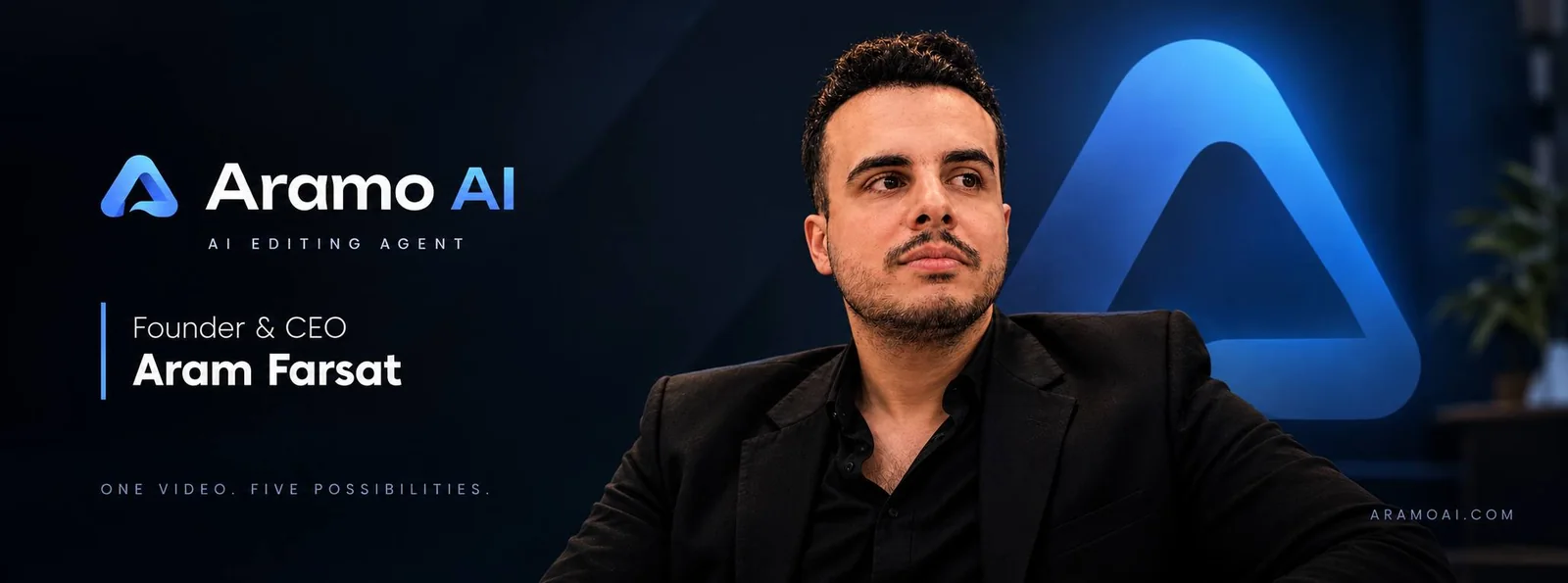
Releases, the thinking behind them, and the person who signs off every one.
Updated 18 September 2026
The founder
The founder who refuses to ship an edit he would not post
Aram Farsat built ARAMO the way he edits: nothing ships until it holds up on real footage. Nine releases in the five weeks after launch, every one of them tested on his own material before a customer ever saw it.
ARAMO exists because its founder is an editor first. He knows what a cheap edit looks like — the cut that lands half a beat late, the caption you cannot read over a bright kitchen, the camera that shakes because software mistook motion for energy — and he will not let a release past him carrying any of it.
That standard is the reason this product moves the way it does. When a style did not look like what it promised, he said so plainly, and it was measured again and rebuilt rather than nudged until the complaints stopped. When an edit repeated a shot, he caught it in the finished video before anyone else did. The result is an editor that is corrected by an editor, on real footage, week after week.
He is also the reason nothing you edit is uploaded. Making a local-first editor is harder than renting somebody else's servers and charging by the minute — it means the analysis, the editing, the rendering and the intelligence all have to run on an ordinary Windows machine. He took the harder road on purpose, because footage belongs to the person who shot it.
Nine releasesbetween 11 August and 16 September 2026
Four enginesediting, the ARAMO Brain, the eye, and ARAMO Director
Six styleseach fitted to measured reference edits
Zero uploadsevery stage runs on the customer's own PC
Aram FarsatFounder & CEO, ARAMO“One video. Five possibilities.”
Newsroom
What ARAMO has shipped
Every item here is a real release, on the date it went out to customers. The full
version-by-version list lives on the changelog.
Release
ARAMO Director: a second editor, in the same app
Choose it per project and a different engine cuts the clip — one that measures every frame before deciding which shots survive.
ARAMO's own editor watches the whole recording and builds the edit from rhythm, speech and movement. ARAMO Director works the other way round: it grades every frame for sharpness, exposure, motion and faces, keeps the strongest shots, and joins them with real cross-dissolves.
Neither engine replaces the other, and you are never stranded. If the Director cannot make a clip, ARAMO's editor makes that clip instead — so a project always comes back finished.
Chosen per project, on the New Project screen
Every frame scored before a shot is kept
Falls back to ARAMO's own editor rather than failing
Inside ARAMO
The ARAMO Brain directs the edit — and can explain itself
Not a chatbot bolted onto a video app: a measured knowledge base that decides how each style cuts, and answers questions about editing with no internet connection at all.
Most editing software hands you sliders and wishes you luck. ARAMO ships with a brain that holds what real edits actually do — pacing, when a transition earns its place, how far the camera moves, how the picture is graded — measured from reference edits rather than guessed at, and applied to your footage automatically.
It is also a page you can talk to. Ask it why an edit feels cheap, or hand it a video and it tells you what it is and how it wants to be cut. Every answer comes from its own knowledge, on your machine, with nothing sent anywhere.
Style rules measured from real reference edits
Answers editing questions offline, on your PC
Can be switched off in Settings if you want the plain edit
Where ARAMO stands
The AI editor that does not take your footage
Cloud clip tools upload your video because that is what cloud means. ARAMO is a Windows application: analysis, editing and rendering all happen on the machine in front of you.
This is the line ARAMO is built on, and the reason the product exists in this shape. Nothing is uploaded, there is no queue behind other people's jobs, no per-minute meter and no cap on how much you edit. Your footage cannot become somebody else's training data, because it never arrives anywhere.
It also keeps working when the internet does not. After the first sign-in ARAMO runs offline for up to a year between licence check-ins — on a plane, on set, or on a connection that would make uploading an hour of 4K a bad joke.
Nothing you edit leaves your PC
No render queue, no per-minute fees, no upload limits
Keeps working offline between licence check-ins
Release
Titles and end cards, rendered into the edit
An opening hook card and a branded sign-off, composited by a real motion engine — now on every edit, whichever engine made it.
Graphics punctuate an edit; they do not blanket it. ARAMO places an opening card where the clip has something true to say, keeps it clear of the captions, and signs off with your own brand name at the end.
Where there is no title to show, no card appears. Inventing one would be worse than leaving the frame alone.
Opening hook card and end card, rendered into the clip
Never printed over a caption
Your own sign-off name, set once in Settings
Release
Music that suits the clip, and ducks under the talking
Different songs under different clips from the same project, chosen from what each clip actually is — and the music steps back before a word is spoken, not after.
ARAMO reads each clip's own energy, cut density and speech, profiles every song in your folder across five moods, and matches them. A calm interview and an action highlight cut from the same source no longer get the same track.
Under speech the music drops automatically, ahead of the line rather than reacting to it, and returns between sentences. When the best available song is not quite the mood the clip wants, ARAMO says so instead of pretending.
A different track per clip, from your own folder
Music down before the line starts, back up between lines
Tells you when the folder has nothing that fits
Release
Real two-clip transitions, without breaking the edit
Cross dissolves, pushes, slides and wipes — genuinely rendering both shots at once, while the clip stays exactly as long as it was planned to be.
Two shots on screen together is the thing most automatic editors approximate with a blur. ARAMO renders the real thing around each cut, from the frames an editor would trim with, and lays it over the boundary — so the timing of the edit never moves.
Cross dissolve, push, slide, wipe, whip and zoom whip
The edit keeps its exact length
Chosen from the moment, not rotated in order
Release
Captions that read on any footage
A real glow behind crisp type, colour on the words that carry the line, and a typeface chosen from the clip itself.
Burned-in captions fail in one of two ways: too thin over a bright scene, or too loud over a calm one. ARAMO measures the footage — how bright it is, how fast it cuts, what colour it leans — and picks weight, glow and emphasis to match, so the words stay readable without shouting.
The same release rebuilt subject tracking, so the vertical crop follows the right person when more than one thing is moving in frame.
Glow behind the type, not smeared across it
Emphasis colour derived from the word, so a clip renders the same way twice
A vertical crop that follows the subject, not the gap between two of them
Release
Six editing styles, built from measurements rather than adjectives
From calm long holds to beat-locked energy — each one fitted to real reference edits, then checked against them again after every change.
“Make it feel more premium” is not something software can act on. So ARAMO measures reference edits instead: how long shots hold, how often cuts land on the beat, how much the camera moves inside a shot, how the picture is graded. The styles are fitted to those numbers and re-checked whenever the editor changes.
That is also why a style can be rebuilt outright. When one did not match what it was supposed to be, it was measured again and replaced — not adjusted until somebody stopped complaining.
The first build went out on 11 August 2026. Nine more followed in the five weeks after it.
Every release since has come from real use: renders that failed on real footage, styles that did not look like what they promised, publishing that stopped at the last step. The full list is public, newest first, on the changelog.
Your footage, your machine
See ARAMO work on your kind of footage
Watch the full demo, ask for a Proof Session on footage like yours, or start today.
Billed 3,275,000 IQD once, for twelve months. Does not renew by itself and no card is kept on file. We email you 30, 7 and 1 days before the year ends, and you renew by buying another year. The yearly licence is non-refundable once payment is confirmed.
Billed 327,500 IQD every month until you cancel. Cancel any time from the link in every receipt — no email to us needed. Cancelling stops the next charge, and you keep ARAMO until the end of the month you already paid for. A month that has started is not refunded.